
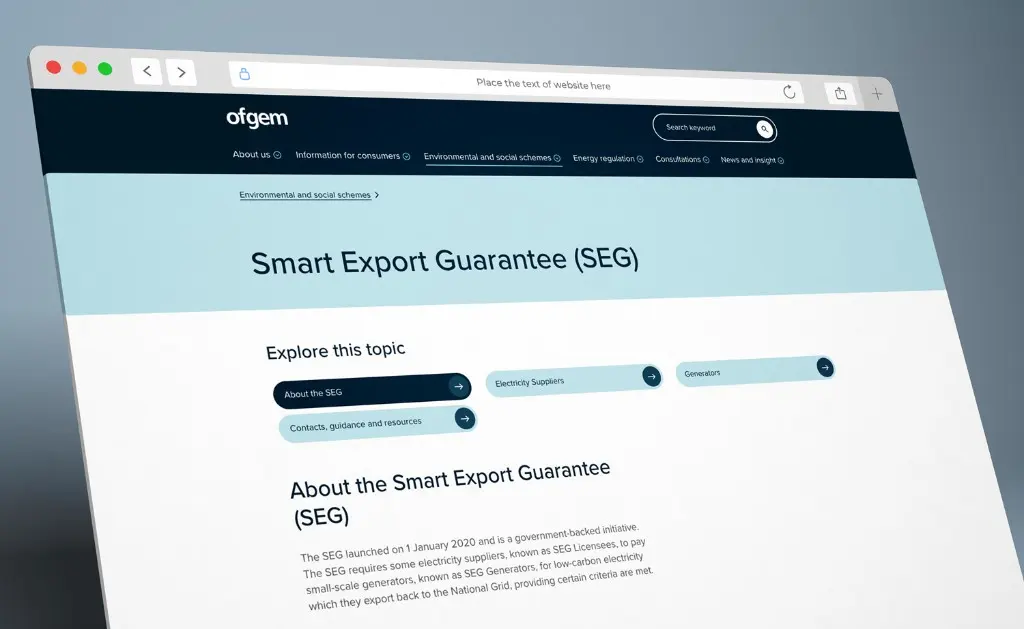
What the Smart Export Guarantee actually is
The Smart Export Guarantee, usually shortened to SEG, is the scheme that pays UK households for the solar electricity they export back to the grid. It launched in January 2020, replacing the older Feed-in Tariff, which closed to new applicants in March 2019.
The two schemes work very differently, and the difference matters if you are weighing up solar economics today. The Feed-in Tariff paid a fixed, government-set rate for every kWh you generated, whether you used it yourself or not, on top of a separate export payment. Households that joined under the FiT locked in rates for 20 to 25 years, and many are still receiving those payments today if their tariff term has not expired.
The SEG only pays for what you export, not what you generate. There is no payment for electricity you use yourself. And critically, the rate is not set by government. Each supplier decides what to pay, which means rates vary enormously across the market, by a factor of five or more between the lowest and highest tariffs available.
Who qualifies, and what you need in place
Any UK supplier with more than 150,000 domestic customers is legally required to offer at least one SEG export tariff. Smaller suppliers can join voluntarily, and several have. To access any SEG tariff, your installation needs to meet a short list of requirements.
- Your solar installation must hold a valid MCS (Microgeneration Certification Scheme) certificate, issued by your installer at the time of installation. This cannot be obtained retrospectively for a non-certified install.
- You need a smart meter capable of recording half-hourly export readings. Without one, your supplier has no way to measure what you have exported and cannot pay you for it.
- Your installer submits a grid connection notification (known as G98 or G99 depending on system size) to your local network operator. This is standard practice and your installer should handle it as part of the installation.
- You apply to a SEG provider directly, providing your MCS certificate number, your electricity meter reference (MPAN), and your smart meter details. This is a separate step from getting your panels installed; SEG registration does not happen automatically.
One detail that surprises a lot of homeowners: your SEG provider does not have to be the same company that supplies your household electricity. Import and export contracts are fully decoupled. You can buy your electricity from one supplier on a competitive fixed tariff and sell your exports to a completely different supplier offering the best SEG rate. Shopping around for both separately is usually worth the small amount of extra admin.
What SEG rates actually look like in 2026
This is where the SEG gets genuinely interesting, and where most solar households are leaving money on the table. Because rates are set competitively rather than centrally, the spread between suppliers is wide, and the best deal depends heavily on whether you have a battery.
| Tariff type | Typical rate | Best suited to |
| Lowest mainstream flat rate | 3p to 7p per kWh | Avoid unless tied in for other reasons |
| Competitive flat rate | 12p to 16p per kWh | Solar without battery, simple and predictable |
| Premium flat rate | Up to 25p per kWh | Solar without battery, best available no-strings rate |
| Time-of-use / peak export | 20p to 30p+ per kWh at peak | Solar plus battery, exporting during evening demand |
Flat-rate tariffs pay the same amount per kWh whatever time of day you export, which suits a household without a battery, since you cannot control when your panels generate anyway. Time-of-use tariffs pay more during specific windows, typically the early evening when grid demand peaks, and less or nothing overnight. These only become genuinely valuable once you can control when you export, which is exactly what a battery allows.
Rates are not fixed once you sign up. Suppliers typically reserve the right to change tariffs with around 30 days notice, and rates move with wholesale electricity prices and competitive pressure between suppliers. A rate that looks attractive today is not guaranteed to stay that way, which is why it is worth reviewing your SEG tariff roughly once a year rather than setting it up once and forgetting about it.
Self-consumption versus exporting: which is worth more?
This is the single most important concept in the entire SEG conversation, and it is the one that gets the least attention in most sales conversations.
Every kWh of solar electricity you generate has two possible destinations. You can use it yourself, in which case you avoid paying your supplier’s import rate, currently around 24 to 29 pence per kWh on a typical standard tariff. Or you can export it, in which case you receive your SEG rate, typically somewhere between 4 and 25 pence per kWh depending on your tariff.
In almost every case, using your own solar electricity is worth more than exporting it, because the import rate you avoid paying is higher than the export rate you would otherwise receive. This is true even on the best available flat-rate SEG tariffs. The only scenario where export becomes more attractive than self-consumption is during a strong peak-time window on a time-of-use tariff, where rates can briefly exceed the import rate.
How a battery changes the SEG strategy
Without a battery, your export pattern is dictated entirely by your solar panels and your household’s consumption at that exact moment. If you generate more than you are using, the surplus exports immediately. You have no control over timing.
A battery changes this completely. Instead of exporting surplus generation the moment it occurs, you can store it and choose when to release it, either back into your home to offset evening consumption, or out to the grid during a high-value export window.
Strategy one: maximise self-consumption
The default and usually best approach. The battery stores daytime surplus and releases it through the evening to cover your own household demand, displacing electricity you would otherwise have bought at the full import rate. This is almost always worth more per kWh than exporting, so it should be the first priority for most systems.
Strategy two: time-shifted export
Once your home’s evening demand is covered, any further stored surplus can be exported during a peak-rate SEG window rather than dribbling out across the day at the standard rate. On a tariff offering 20 to 30 pence per kWh during a defined peak period, this can be worth significantly more than exporting the same electricity earlier in the day on a flat rate.
Strategy three: arbitrage on time-of-use import and export
The most sophisticated approach, available through certain combined import and export tariffs, charges the battery overnight using cheap off-peak grid electricity, often 5 to 8 pence per kWh, and exports stored energy the following evening at the peak SEG rate. The system profits on the spread between cheap import and expensive export, on top of whatever solar self-consumption it is already providing. This requires a smart inverter capable of scheduled charging and discharging, and a supplier tariff that supports it.
| Approach | Battery required | Typical added value per year |
| Export only, no battery, flat tariff | No | Baseline, lowest return |
| Self-consumption boost with battery | Yes | £150 to £300 |
| Self-consumption plus peak-time export | Yes, with TOU tariff | £250 to £450 |
| Full arbitrage: cheap import, peak export | Yes, with smart scheduling | £400 to £700+ |
These figures are illustrative and depend heavily on your system size, your household’s consumption pattern, and which specific tariff you are on. The general pattern holds across most installations: the more control you have over when electricity moves in and out of your home, the more total value you extract from the same solar panels.
What a typical UK household actually earns
Numbers vary by region, system size, and tariff choice, but a reasonable illustration helps put the figures in context. A 4 kWp solar system without a battery, in an average UK location, typically exports somewhere between 1,500 and 2,800 kWh per year, the portion of its roughly 3,400 kWh annual generation that is not used directly in the home.
| System profile | Estimated annual export | Income range |
| 4 kWp solar, no battery, low-rate tariff | 1,500 to 2,800 kWh | £60 to £200 |
| 4 kWp solar, no battery, best flat-rate tariff | 1,500 to 2,800 kWh | £225 to £700 |
| 4 kWp solar plus battery, time-of-use tariff | Lower export volume, higher value per unit | £400 to £800 |
| 6 kWp solar plus larger battery, full TOU strategy | Variable, optimised for peak windows | £600 to £1,200 |
Notice that the battery scenarios export fewer raw kilowatt-hours than the no-battery scenarios, yet earn more overall. That is the entire point of pairing storage with a smart export strategy: fewer units sold, at a much better price, plus the self-consumption savings the battery provides on top.
It is worth remembering that for most owner-occupied homes, SEG income is not subject to income tax under current HMRC treatment of domestic microgeneration. Landlords and businesses face different rules, and anyone in that position should take specific advice rather than assuming the same exemption applies.
How to choose between SEG tariffs
With roughly thirty live SEG tariffs on the UK market, comparing them properly takes more than glancing at the headline rate. A few questions are worth asking before switching.
- Is this a flat rate or a time-of-use rate? Flat rates are simpler and suit households without a battery. Time-of-use rates only pay their best headline figure during specific windows, and you need the ability to control your export timing to capture it.
- Does it require bundling with an import contract from the same supplier? Several of the highest-paying tariffs are only available to a supplier’s own import customers. Factor in whether switching your whole household supply is worth it, not just the export rate in isolation.
- Is my battery compatible? Time-of-use and arbitrage tariffs typically require a specific list of approved battery and inverter combinations to enable smart scheduling. Check the supplier’s compatible equipment list before assuming your system qualifies.
- Can the battery be charged from the grid, and does that affect eligibility? Some tariffs restrict or exclude grid-charged batteries from SEG payments. If your strategy depends on cheap overnight charging, confirm this is permitted under the specific tariff you are considering.
- How often does the rate change, and what notice will I get? Fixed tariffs typically hold their rate for an agreed term. Variable tariffs can move with wholesale prices, sometimes significantly. Understand which type you are signing up for.
Getting the system built right from the start
The SEG strategy you can run is only as good as the equipment underneath it. A battery and inverter combination that cannot communicate with your chosen supplier’s scheduling platform will not be able to access time-of-use or arbitrage tariffs, no matter how good your intentions.
- Confirm MCS certification is included and provided at completion. Without it, no SEG tariff is available at all.
- Ask which SEG tariffs and suppliers your proposed battery and inverter combination is compatible with, before you commit to specific equipment.
- Request confirmation that your smart meter supports half-hourly export readings. Older first-generation smart meters sometimes do not, and an upgrade may be needed.
- If you want a time-of-use or arbitrage strategy, ask specifically whether the inverter supports scheduled, automated charge and discharge cycles, rather than manual control only.
- Get the grid connection notification confirmed in writing as part of your installation paperwork. This is a legal requirement for systems above a certain size and your installer should handle it as standard.
How Apollogrid helps you get the most from the SEG
Most solar households are on the wrong SEG tariff, or not registered at all. We see this regularly when homeowners come to us after having had a system installed elsewhere. The panels are generating, the surplus is exporting, and the household is either receiving a fraction of what a better tariff would pay, or nothing at all because the SEG registration was never completed. Getting this right is part of what we do.
Designing the system for your export strategy, not just your roof
Before we specify any equipment, we ask about your electricity usage patterns, your current or intended tariff, and whether you want to prioritise self-consumption, export income, or both. These are not afterthoughts. A household aiming for time-of-use export payments needs a different inverter and battery specification to one primarily focused on overnight self-sufficiency, and the time to make that decision is before the installation, not after.
Inverter and battery combinations built for smart tariffs
Apollogrid installs high voltage LFP battery systems paired with hybrid inverters that support automated time-of-use scheduling from day one. This matters for SEG because the most valuable export tariffs, those paying 20 to 30 pence per kWh during peak windows, require the system to control exactly when it exports. An inverter that can only be adjusted manually, or that is not on a supplier’s approved compatibility list, cannot access those tariffs regardless of how good the panels are.
We confirm compatibility between the specific battery, inverter, and target tariff before anything is ordered. If a customer’s preferred supplier does not support their proposed system, we say so before the installation, not after.
MCS certification, SEG registration, and smart metering handled as standard
Every Apollogrid installation is MCS certified, which is the non-negotiable baseline for any SEG tariff. We provide the MCS certificate at handover and can assist with SEG registration directly. We also confirm at the survey stage whether your smart meter supports half-hourly export readings, since without this a supplier cannot measure what you are exporting and cannot pay you for it. If an upgrade is needed, we flag this before installation begins rather than leaving it as an obstacle to discover afterward.
Talk to Apollogrid about your SEG setup
Whether you are planning a new installation or reviewing an existing system, we will confirm your MCS certification, check your smart meter, compare the current SEG tariff options for your setup, and make sure your inverter can actually deliver the export strategy you are aiming for.