
Why the panel brand actually matters
Most homeowners shopping for solar focus on the installer and the price, and treat the panel itself as a commodity. To a degree, that instinct is reasonable: the panel market has matured enormously over the past decade, and even a mid-range panel today is a far more capable product than anything available ten years ago.
But panels are not all the same, and the differences that remain are genuinely worth understanding before signing a quote. Cell technology affects how much electricity a panel generates per square metre, which matters most when roof space is limited. Degradation rate affects how much output survives to year twenty-five. And on a UK roof specifically, low-light performance, how well a panel handles the overcast, diffuse daylight that defines a large share of the British year, has a real and measurable effect on annual generation that a sunny-day spec sheet does not fully capture.
LONGi is one of the more frequently specified panel brands in UK residential solar in 2026, and its Hi-MO X10 range, built on back-contact cell technology, sits toward the premium end of what is commercially available for a domestic roof. This guide works through what that technology actually does, what the manufacturer’s own figures show, and where these panels make practical sense for a UK home.
What HPBC back-contact technology actually does
LONGi’s Hi-MO X10 range uses what the company calls HPBC 2.0, Hybrid Passivated Back Contact technology. The basic idea is straightforward even if the manufacturing is not: on a conventional solar panel, the metal wiring that collects current sits on the front of the cell, in thin visible lines called busbars. Those busbars block a small amount of incoming light from ever reaching the silicon underneath.
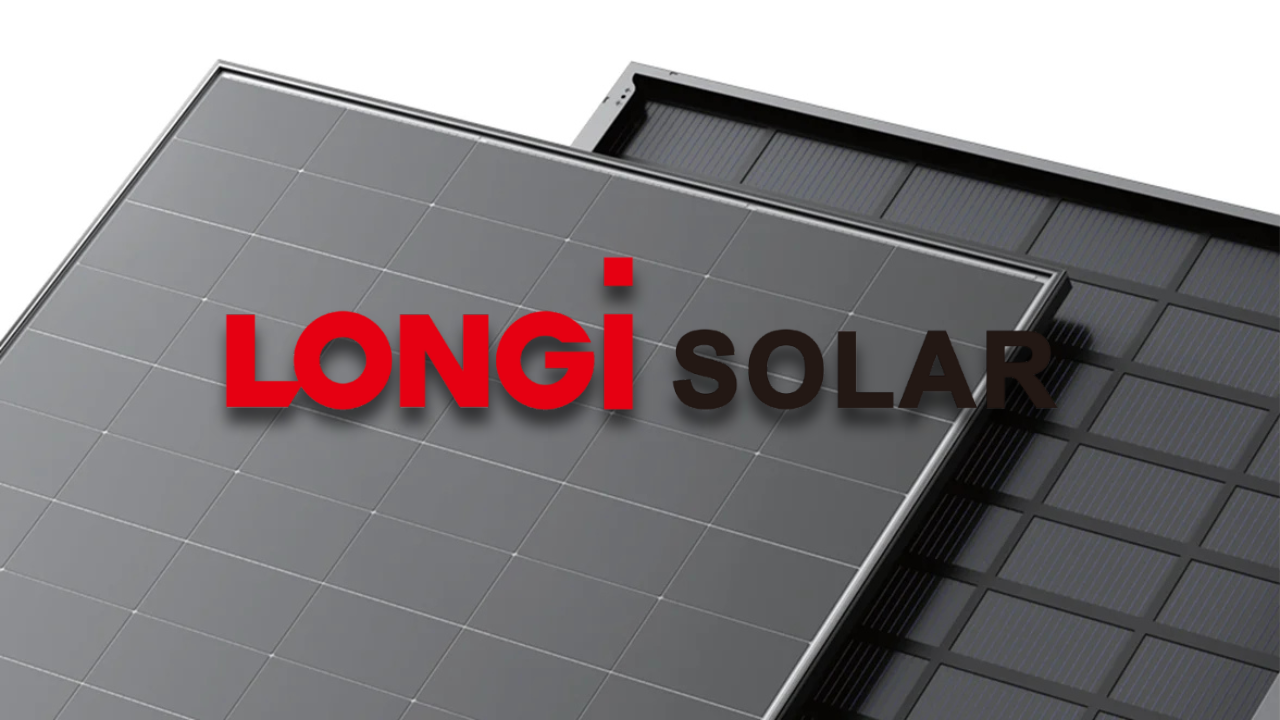
A back-contact cell moves all of that wiring to the rear of the panel instead. The front surface is left completely clear, which does two things. It increases the surface area actually available to capture light, contributing to the higher efficiency figures the technology achieves, and it gives the panel a distinctive, uniform black appearance with no visible gridlines, something a growing number of UK homeowners specifically ask for on aesthetic grounds, particularly for properties in conservation areas or with strict planning sensitivities around visible roof alterations.
The manufacturer’s own datasheets for the Hi-MO X10 range also highlight two further characteristics of the design: an anti-shading function intended to reduce the impact of partial shading and prevent localised overheating in shaded cells, and a lower operating temperature under shade compared with conventional panels, which the manufacturer’s testing puts at over 60 degrees Celsius cooler in shaded conditions. Both characteristics are particularly relevant to UK roofs, where chimneys, dormer windows, and overhanging trees create partial shading far more often than they do on a large, uninterrupted commercial array.
The Hi-MO X10 range: manufacturer specifications
LONGi’s residential lineup includes several Hi-MO X10 variants, differing primarily in physical size, cell count, and the resulting power and efficiency band. The table below sets out the verified manufacturer specifications for three current variants relevant to UK residential installation.
| Model | Power range | Module efficiency | Dimensions |
| EcoLife X10 Single Glass Black (LR7-54HVB) | 475 to 495W | 23.3% to 24.3% | 1800 × 1134 × 30mm, 21.6kg |
| Hi-MO X10 (LR7-54HVH) | 480 to 500W | 23.5% to 24.5% | 1800 × 1134 × 30mm, 21.6kg |
| Hi-MO X10 Scientist (LR7-72HVH) | 640 to 670W | 23.69% to 24.80% | 2382 × 1134 × 30mm, 28.5kg |
The first two variants share the same physical footprint and 108 half-cell construction, making them the directly comparable standard-format option for a typical UK residential roof. The Scientist variant uses a larger 144 half-cell format and a notably bigger panel footprint, at over 2.3 metres in length, putting it closer to the format more commonly used on larger roofs, barns, and commercial-leaning residential projects than on a standard semi-detached or terraced house.
| Specification | Manufacturer figure |
| First year power degradation | Less than 1% |
| Annual degradation, years 2 to 30 | 0.35% per year |
| Power output tolerance | 0 to +3%, never below rated output |
| Temperature coefficient of Pmax | -0.260% per °C |
| Maximum static loading, front | 5,400 Pa |
| Hailstone resistance | 25mm hailstone at 23m/s impact speed |
| Fire rating | IEC Class C |
| Maximum system voltage | DC1500V (IEC) |
The degradation figures are worth pausing on. A panel losing less than 1% of its rated output in the first year and roughly 0.35% per year after that retains a substantial majority of its original output by year thirty, broadly consistent with the 30-year linear power warranty LONGi provides on this range, which the manufacturer’s own warranty curve shows guaranteeing 88.85% of original output retained at year thirty.
Performance in UK low-light conditions
The UK does not get a great deal of direct, unbroken sunshine compared with southern Europe or other major solar markets, and any honest conversation about solar panel choice in Britain has to start from that reality rather than around it. What matters in practice is not peak output on a cloudless July afternoon, since that happens on relatively few days a year, but how a panel performs across the much larger number of overcast, hazy, and partially cloudy days that make up the bulk of the British calendar.
Manufacturer datasheets report two performance figures relevant to this: output under Standard Test Conditions, abbreviated STC, which simulates strong, direct, full-intensity sunlight, and output under Nominal Operating Cell Temperature conditions, abbreviated NOCT, which simulates a more moderate 800 W per square metre irradiance at a lower ambient temperature, a closer proxy for typical UK daylight than the STC figure.
| Variant | STC output (peak sun) | NOCT output (moderate UK daylight) | Ratio retained |
| LR7-54HVB-495M | 495W | 377W | 76.2% |
| LR7-54HVH-500M | 500W | 381W | 76.2% |
| LR7-72HVH-670M | 670W | not separately listed by manufacturer | see datasheet |
Retaining roughly three-quarters of peak rated output under the more moderate NOCT test condition is a reasonable real-world indicator of how a panel behaves outside the brief windows of genuinely strong direct sun. Beyond the raw numbers, the back-contact architecture itself is part of why LONGi’s HPBC technology has earned a reputation for comparatively strong diffuse-light performance: by removing the front-side wiring, more of the cell’s surface area remains available to capture scattered, indirect light, which is the dominant light condition for a large share of the UK year.
Installation suitability: which UK roofs these panels fit
The right LONGi panel for a given home depends heavily on roof size, shape, and what the homeowner is optimising for, efficiency per square metre, total system cost, or aesthetics.
Standard UK residential roofs
The standard-format Hi-MO X10 and EcoLife X10 variants, at 1800 by 1134 millimetres and roughly 21.6 kilograms, are sized comfortably for the great majority of UK semi-detached, terraced, and detached roofs, fitting the same general footprint as most competing tier-one panels on the market. For a typical three or four-bedroom home, these are the relevant LONGi variants to specify.
Larger roofs and outbuildings
The Scientist variant, at over 2.3 metres long and 28.5 kilograms, is a meaningfully larger and heavier module, better suited to larger uninterrupted roof areas, barns, and outbuildings where its higher per-panel output, up to 670W, can be put to full use without the panel dominating a smaller pitched roof awkwardly. A proper structural assessment matters more for this variant given the additional weight per unit.
Shaded or complex roofs
The manufacturer-stated anti-shading function and reduced hot-spot risk under partial shade are genuinely relevant here. No panel technology eliminates the output loss caused by shading entirely, but a panel architecture specifically engineered to limit localised overheating under partial shade is a meaningful consideration for roofs with chimneys, dormers, or nearby trees that cast intermittent shadows across part of the array.
Aesthetic-priority installs
The gridline-free black finish achieved by moving wiring to the rear of the cell is a genuine differentiator for listed buildings, conservation areas, and any homeowner who simply wants the cleanest possible roof appearance. This is a legitimate factor in the decision for many UK buyers, not merely a marketing point.
How Apollogrid supports a LONGi installation, start to finish
Choosing a strong panel is only part of getting a good outcome. The quality of the survey, the design, the installation, and the ongoing support around it matters just as much, arguably more, over a 25 to 30 year system life.
- Site survey and shading assessment. Before recommending a specific LONGi variant, we assess your actual roof dimensions, orientation, and any shading from chimneys, trees, or neighbouring structures, since this directly determines which panel format and system size genuinely fits your property.
- Panel selection matched to your roof and goals. Standard-format Hi-MO X10 panels for most homes, the larger Scientist variant where roof size and structure support it, and a clear explanation of the trade-offs between efficiency, cost, and aesthetics for your specific situation.
- MCS-certified installation. All Apollogrid installations are carried out to current UK certification standards, ensuring eligibility for the Smart Export Guarantee and compliance with grid connection requirements.
- Full warranty documentation and registration. We confirm and register the specific warranty terms applicable to your installed panel model, both the materials and processing warranty and the linear power output warranty, with the exact figures for your specific LONGi variant provided in writing at handover.
- Ongoing monitoring and servicing support. Once installed, we provide monitoring app setup, scheduled servicing, and a clear point of contact for any warranty query for the life of the system.